The Continuity Error Is Not Always a Story Error
Learn how to read a continuity error without mistaking a small shot mismatch for a story problem, and decide when the inconsistency changes meaning.
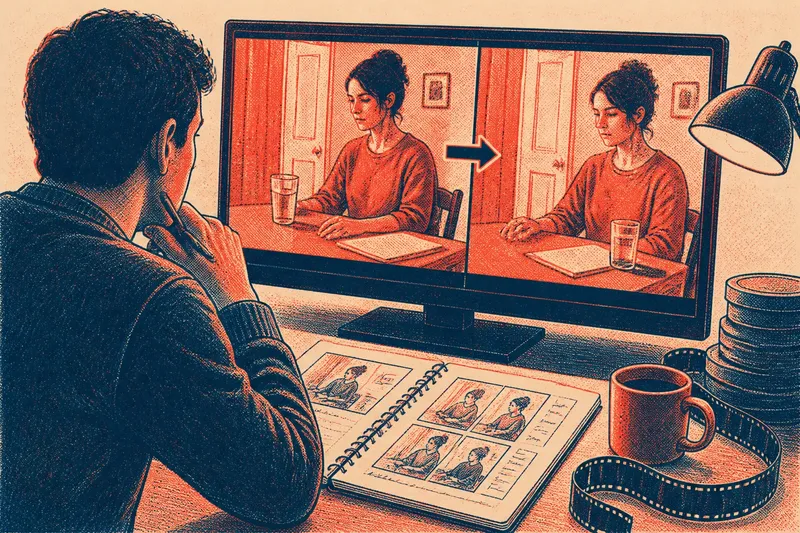
The common mistake with a continuity error is to treat every mismatch between shots as evidence that a story has gone wrong. A continuity error can be as small as a glass moving across a table, yet calling it out does not explain what the change means—or whether it matters at all. The useful question is not simply, “Did something change?” It is, “What does the change do to the scene?”
A mismatch is an observation, not an interpretation
Continuity is the sense that details and actions carry coherently across edits. A character reaches for a cup in one shot; in the next, the hand and cup occupy positions that do not quite follow. The viewer notices a discontinuity in the image. That observation is specific, but it does not yet tell us whether the scene’s meaning has shifted.
Film and television scenes are assembled from separate takes and camera angles. The finished sequence has to make these pieces feel like a continuing event, while also choosing the clearest performance, composition, timing and sound. A small difference can survive the edit because other priorities matter more, because the audience is attending to something else, or because the detail never affects the action being told.
It helps to separate three things: the visible mismatch, its effect on the scene and any interpretation we build from that effect. A sleeve changing position is the mismatch. Whether that change makes a movement hard to follow is its possible effect. Claiming it reveals a character’s state of mind is an interpretation, and needs more support than the mismatch alone.
Ask whether the difference changes the action
Begin with the scene’s practical action. Who is doing what, what changes, and what does the next shot ask the viewer to understand? Then check whether the mismatch alters one of those answers.
- Does it change an object’s role? A prop that seems to appear before anyone retrieves it may make an action confusing. A small shift in where a glass rests may leave the exchange perfectly clear.
- Does it disrupt cause and effect? If a character appears to react before the event that prompts the reaction, the scene may read differently. A slightly altered hand position usually does not create that problem.
- Does it change who knows or has done something? A character who seems to hold a letter before receiving it can affect the scene’s information. A crease appearing on the letter may not.
- Does the next shot repair or deepen the mismatch? A return to the earlier position can make a one-off slip easy to overlook. Repeated changes may instead make the action feel deliberately unsettled.
These questions do not decide whether a crew intended the difference. They help establish what a viewer can reasonably infer from the finished sequence. Production intent is often unavailable; the work’s observable effects are available in the image and sound.
Scale the consequence before assigning meaning
A useful distinction is between a continuity difference that is visible and one that is consequential. Visibility is about whether you can spot it. Consequence is about whether it changes comprehension, emphasis or emotional pressure. A mismatch can be conspicuous yet harmless to the story, or subtle yet important because it changes the order in which information arrives.
For instance, imagine a scene where a person sets a key beside a bowl, then reaches for it after hearing a knock. In the second camera angle, the key sits a little nearer the bowl’s edge. If the person still finds it and the knock still motivates the movement, the shift is likely a minor visual inconsistency. If the key has disappeared and the person’s next action depends on having picked it up, the sequence may leave the action unclear. The difference matters because of its effect on the event, not because the key moved.
Even a consequential mismatch need not be a “story error” in the broad sense. A scene might remain understandable but lose a beat of suspense, weaken a gesture or make a relationship harder to read. Name that particular effect instead of treating every flaw as a broken plot. Precision keeps criticism tied to what the sequence actually does.
Look for a pattern before reading a deliberate choice
Some apparent inconsistencies can take on expressive force through repetition, contrast or timing. A cut might return to a prop in a changed position as a character becomes distracted. A sequence might repeatedly interrupt smooth action, making the scene feel fragmented. Those patterns can support an interpretation—but a single mismatch rarely establishes one by itself.
To test a reading, compare the difference with nearby choices. Does the camera return to the altered detail? Does the edit give it unusual emphasis? Does the sound or performance draw attention to the same moment? Does the pattern recur in a way that changes how the scene feels? If the answer is no, an accidental mismatch may be the simpler account. If the detail is repeatedly framed or made consequential, a viewer has more reason to consider its expressive role.
This is not a rule that deliberate choices must be conspicuous. It is a reminder to distinguish an interpretation from the evidence supporting it. “The cup changes position” describes what is on screen. “The scene uses the cup’s shifting position to unsettle us” describes an effect and offers a reading. The second claim needs a pattern or a clear connection to the scene’s action.
How should you read a continuity error?
Does every continuity error matter?
No. Some mismatches are easy to see but have no meaningful effect on the scene’s action or information. Note what changes, then ask whether a viewer’s understanding or experience changes with it.
Can a continuity error be intentional?
It can be read as intentional when the sequence gives the difference a clear role through emphasis, repetition or connection to the scene’s effects. A mismatch alone cannot establish the production’s intention.
What is the difference between a continuity error and a plot hole?
A continuity error is a mismatch in how details or actions connect across shots. A plot hole is a problem in the story’s logic; a shot mismatch might contribute to one, but many continuity slips leave the plot untouched.
Should you pause to inspect every mismatch?
Only if it helps answer a question about the scene. If the moment remains clear and the detail has no apparent consequence, returning to the shot may not add much to your reading.
Keep the description narrower than the claim
When discussing a suspected continuity error, describe the shots before explaining them. “The folder is closed in the first angle and partly open after the cut” gives others something they can check. “The character must have changed their mind” jumps from a visual difference to a motive without showing the link.
Then state the consequence at the right scale: the action becomes harder to follow, a reaction seems premature, or the difference does not alter the scene’s meaning. This approach is especially useful when talking about scenes with quick cuts, overlapping dialogue or performance that changes slightly across angles. It keeps the discussion about the finished work rather than turning every visible discrepancy into a claim about the crew.
It is not worth the effort to build a theory around every shifting prop or altered sleeve. Save close inspection for a mismatch that interrupts your understanding, changes what a character appears to do, or forms a noticeable pattern. A continuity error is worth naming when you can explain its effect; the label alone is not the interpretation.
Next time you spot a continuity error, separate the detail from its consequence before deciding what it means. That small pause makes film reading more exact: you can identify the mismatch without mistaking it for a story failure, and follow the sequence’s evidence before making a larger claim.