A One-Scene Rewatch for Following a Character’s Goal
A one-scene rewatch helps you track what a character wants, what changes and how performance signals the shift without losing the scene’s flow.
The common mistake in a one-scene rewatch is to decide too early what a character wants, then treat every glance as proof. That can flatten a performance into a puzzle with one answer and obscure the moment the character’s aim changes. A one-scene rewatch works better when you separate what is said from what the actor makes visible.
Choose the rewatch that fits your question
Start with the question that brought you back to the scene. You do not need to inspect every detail on every pass; choose a route that suits the uncertainty you have.
- If the character’s goal is unclear, listen for requests, refusals, bargains and interruptions. This suits scenes where the dialogue seems indirect, because a character’s aim often emerges through what they try to get another person to do.
- If the goal seems clear but the scene feels different by the end, compare the character’s behaviour at the opening and closing. This suits scenes where a change in status, willingness or confidence matters more than a new piece of information.
- If the dialogue does not explain the shift, watch the actor’s timing, posture, gaze and use of space. This suits scenes built around concealment, hesitation or a decision that is not spoken aloud.
- If several characters seem to want different things, follow one character per pass. This keeps competing aims legible instead of turning the scene into a general impression of tension.
Pick one route, watch the scene without pausing, and keep your notes brief. A single line for the opening, a line for the turning point and a line for the ending are enough to give the next pass a purpose.
Write the goal as an action, not a mood
“Anxious” or “angry” describes a possible feeling; it does not say what the character is trying to achieve. Use an active phrase such as “get Mara to stay”, “avoid answering the question” or “persuade the manager to reconsider”. The wording should name an outcome another person could accept, resist or prevent.
Separate the character’s goal from the scene’s larger plot. A person may want to keep a conversation going even when the story’s larger conflict concerns a job, a family or a public decision. The immediate goal is the one you can track inside the scene.
On the first viewing, note the opening situation in plain terms: where the character is, who is present and what is already at stake. Then write a provisional goal, marking it with a question mark if the evidence is thin. That small qualification stops an early guess becoming an unquestioned conclusion.
Track what changes without forcing a turning point
On the next pass, look for a change in the character’s options or tactics. A request may become a threat; a confident answer may turn into silence; someone who has been steering the exchange may start reacting instead. These are observable changes, even if the character’s deeper motive remains uncertain.
Mark the moment that prompts the shift. It might be a new fact, another person’s refusal, an unexpected entrance or the character’s own decision to stop pretending. If no single moment stands out, note that the change accumulates gradually rather than naming a dramatic beat the scene does not provide.
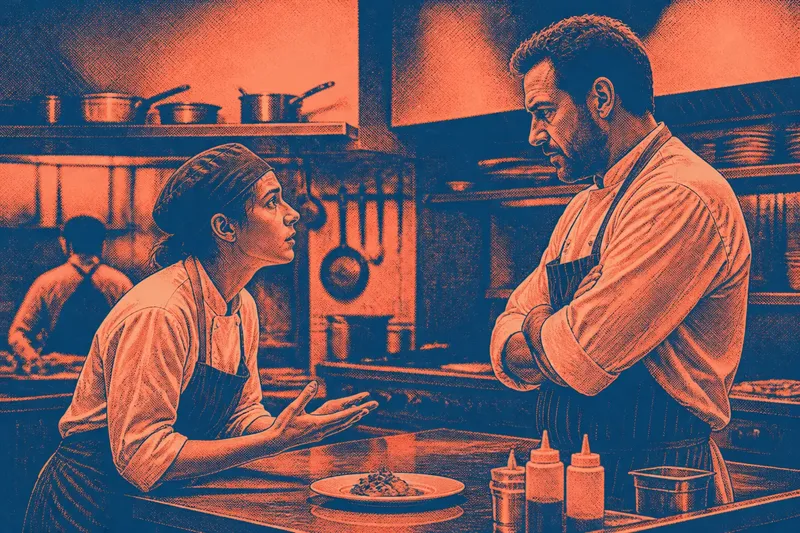
Say you are rewatching an invented scene in which a junior chef asks a head chef to keep a menu item. At first, the junior chef offers reasons tied to the kitchen’s routine; after the head chef dismisses them, the junior chef admits the dish belonged to a late mentor. You might note a shift from seeking approval to asking for recognition, then check whether the actor’s behaviour supports that reading.
Read performance through specific choices
Watch the actor, not just the dialogue. Notice when they begin speaking, whether they answer immediately, where their attention goes, and how they hold or release their body. A performance can make a change legible through a pause before a name, a gaze that stops seeking approval, or a newly direct stance.
Describe what is visible before assigning a feeling. “Looks down before agreeing” is an observation; “feels ashamed” is an interpretation. Put the interpretation beside the evidence rather than replacing it with the evidence. This distinction is especially useful when the actor keeps the emotion restrained or the scene leaves more than one reading open.
Compare the same behaviour across the scene. A character’s silence at the start may be evasive, while silence later may be a refusal to continue. The gesture alone does not settle its meaning; its place in the exchange and the actor’s changing attention help you judge what it does.
What should you watch for on another pass?
What if the character never states a clear goal?
Track the practical effect they seem to want from the other person, such as agreement, reassurance or a change of subject. Keep your wording tentative if the scene supports several aims.
How can you tell a changed tactic from a changed goal?
A changed tactic is a new way to pursue the same outcome, such as switching from a joke to a direct request. A changed goal means the desired outcome itself appears different, so compare what the character seeks at the opening and the end.
Should you pause the scene while watching?
Watch once without interruption so timing and reactions remain intact. Pause on a later pass only when you need to check a specific gesture, line or exchange that bears on your question.
What if two readings both fit?
Keep both, then identify which details support each one. An unresolved motive can be part of the scene’s design, not a failure of your rewatch.
Keep the notes small and useful
Use a simple three-part record: “wants”, “changes when” and “performance shows it through”. For instance, “wants a second chance; changes after the refusal; stops smiling and answers without looking away” links an interpretation to visible behaviour without turning the scene into a transcript.
What is not worth the effort is assigning a precise emotion to every facial movement or replaying a whole scene to settle a detail that does not affect your reading. If a gesture remains ambiguous, record that uncertainty and move on. The aim is to follow a character’s goal, not to claim access to a private thought.
A one-scene rewatch is most useful when you finish with a claim you can point back to: what the character wanted, what altered the situation and which performance choices made that alteration apparent. Keep the main phrase “one-scene rewatch” tied to that process: observe first, interpret second, and leave room for evidence that does not fit neatly.