Before the Cut: How Early Film Scenes Held Together
Early film editing often relied on sustained views. Learn how staging, entrances and changing cuts organise action and guide attention across silent cinema.
The most common mistake in watching early film editing is to treat every sustained view as a scene waiting for proper cutting. That assumption hides the work done by entrances, gestures and carefully arranged bodies. In films made during the silent era, these choices could make action legible without frequent changes of view—but practices varied by country, period, genre and filmmaker.
In particular, the following discussion concerns narrative films from the late nineteenth century through the silent era, rather than every kind of early moving image. A French trick film, a British actualité and a US dramatic short did not necessarily organise action in the same way. Watch how a particular scene directs your attention, instead of treating one national tradition or decade as the universal model.
A fixed camera made the frame work like a stage
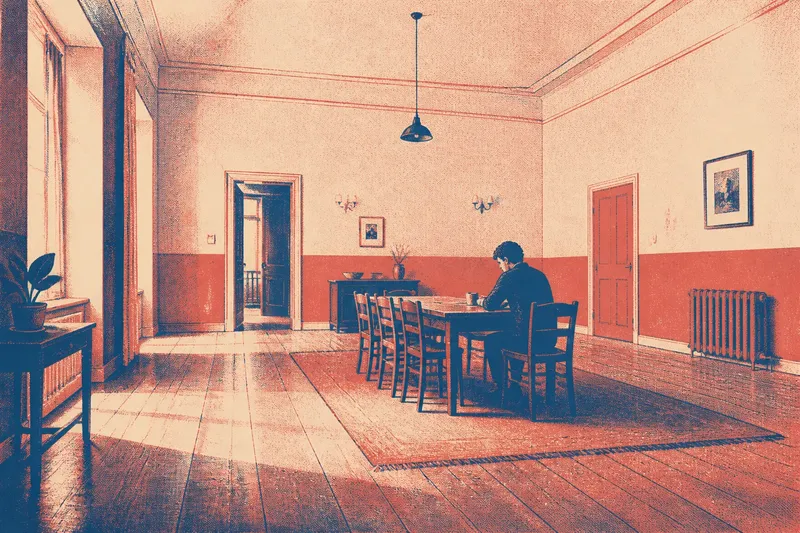
In many early narrative films, especially some short dramas, the camera remains in one position while performers enter, cross the space and leave. The frame can resemble a proscenium: viewers look towards an arranged field as action unfolds within it. A doorway, table or open patch of floor serves as a landmark, helping show where a character is and where they can go.
This is not simply unplanned recording. Camera placement determines which movements remain visible and which parts of the setting matter. A performer who turns away from the lens can still communicate through posture, gesture or another character’s response. The image asks viewers to read bodies in relation to the whole composition, rather than following a close view of a face.
Without a change of angle to redirect attention, performers may make actions readable through clear timing and direction. One character approaches another, pauses and makes a significant gesture; viewers see the sequence as a continuous event. A sustained view can also keep several people in the image, making their reactions part of the same composition.
The limitation is just as visible. A small expression may be hard to see, while activity near the edge of the frame can compete with the main action. A fixed view gives viewers room to scan but does not always tell them where to look. That tension helps explain why editing could guide attention within a scene, not merely shorten a film.
Entrances and exits punctuated the action
When a scene holds to one view, a character’s arrival can work like a new paragraph. Someone enters through a door or from beyond the frame; another person notices; the balance of the space changes. The entrance supplies a fresh event without a new shot. An exit can close one strand of action, leaving others to react or continue.
These movements can also make a room’s geography understandable. If a character repeatedly enters from one side and crosses towards a desk, viewers can infer a route. A later arrival from the opposite side reads as a different approach. The set is not just background: doors, furniture and open paths help organise the scene.
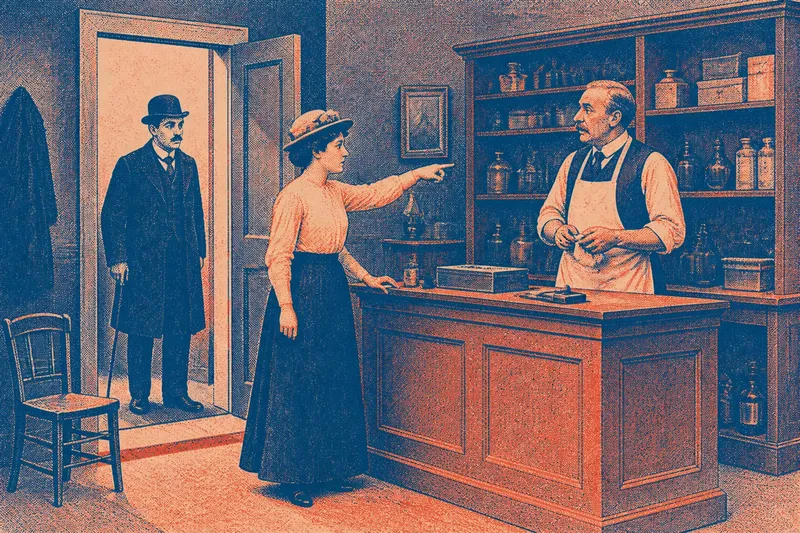
Say you are watching an invented silent-era shop scene: a shopkeeper arranges objects on a counter when a customer enters and points towards a shelf. The shopkeeper crosses the room and retrieves an item while the customer waits beside the counter. The starting positions and visible gesture make the action’s cause and result readable in one view; if the point were obscured, the audience might not understand why the shopkeeper moved.
Ask what changes when someone enters or leaves. Watch who controls the space, who has to wait and which doorway carries the next development. The frame may stay steady while the relationships inside it shift.
Staging let one image carry several actions
Staging is the arrangement of performers and action within a shot. A foreground figure might handle a prop while another person waits behind, then steps forward when called. Viewers can see an action and its consequence together. Blocking, gestures and pauses establish the order of events without a cut to explain each one.
Props can provide a visual thread. A letter passes across a table; one character reads it while another watches; the reader folds it or hands it on. The object links the participants and gives the scene a visible centre. If it disappears from view or is handled ambiguously, viewers may lose track of what has changed. Its placement and movement can therefore carry plot information.
Group scenes use the same principle. A person at the centre may speak or act while others form a listening line, gather around a table or keep their distance. The arrangement shows who is involved and who remains outside the exchange. A reaction can register even without a close view if the performer’s turn or gesture stands out against the surrounding action.
Staging can make sustained action feel rich, but it asks viewers to divide their attention. They might notice a central gesture and miss a quieter reaction elsewhere in the frame. That is not automatically a flaw: control is distributed differently. Viewers scan the image, while a cut-driven scene can direct attention by selecting the next view.
Intertitles and repeated views linked events
Silent-era films often used intertitles: written cards placed between images to supply dialogue, identify a place or time, or clarify a development. A title card could bridge a gap in what the image showed, but it did not replace visual action. The following shot still had to establish who was present and what was happening.
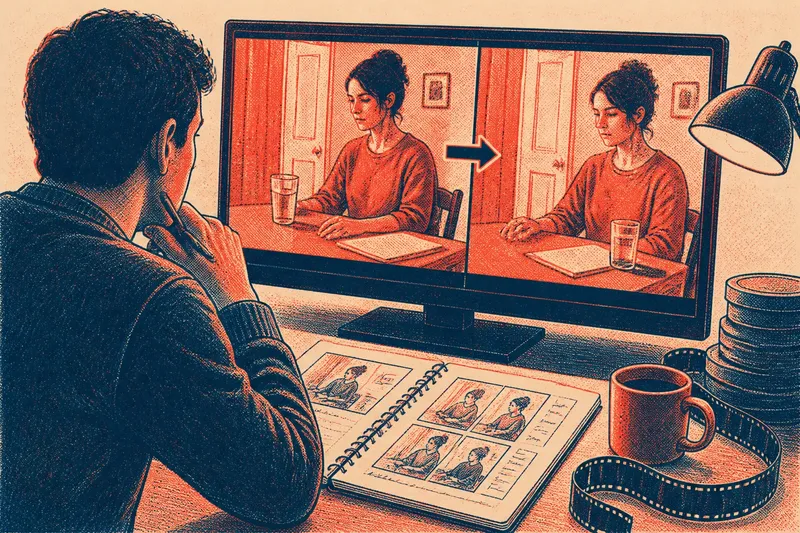
Some early narratives also presented separate scenes, each arranged to be understood on its own. A story might return to an event from another viewpoint or repeat part of an action. Depending on the film and its context, repetition could make relationships easier to follow, intensify a moment or provide information missing from the first view. It is not automatically a continuity mistake; ask what the repeated image adds.
As editing conventions developed unevenly across national industries and individual filmmakers, some films divided a continuous event into multiple views. A wider shot might establish a room, followed by a closer view of a person reacting. The cut links the images in the viewer’s mind: the face belongs to the space just seen, and the reaction belongs to the ongoing exchange. This differs from an intertitle, which interrupts the pictured action to convey words or information.
Transitions between places and moments also became ways to shape pace. A cut can omit travel, move to another location or jump forward after an action has begun. Viewers need cues to recognise the change, such as a new setting, a changed costume, an arriving character or an intertitle. Notice which cue carries the transition rather than expecting every movement to be shown.
Cutting redirected attention and reshaped time
When filmmakers changed the view within a scene, they could steer attention more directly. A close view can make a hand, face or object important; a return to a wider view restores the action to its surroundings. The cut changes not only image size but also the order in which information reaches viewers.
Editing can compress time: a character begins a journey in one shot and appears at the destination in another, with the travel omitted. It can also stretch a charged instant by moving between reactions, or make separate actions seem connected by placing them next to each other. These choices shape suspense and emphasis. Viewers might see a threat before a character does, or learn about a reaction only after the action that caused it.
A change in editing did not make sustained views obsolete. A continuous shot can preserve the rhythm of a performance, keep several relationships visible at once or make an entrance feel consequential. Cutting offers a different kind of guidance, and its effect depends on what the scene asks viewers to notice and when. A quiet exchange may leave room to observe; a sudden revelation may call for a closer view.
What should you look for in an early film scene?
Does a fixed view mean the scene is unedited?
No. A scene may be one shot within a film assembled from several shots, and the camera can remain still while staging guides attention. Watch for changes in setting or time between views as well as movement within the frame.
How can you tell where characters are moving?
Track entrances, exits, doors, furniture and repeated routes across the frame. If a character crosses to a prop or another person, note what prompted the movement and what changes afterwards.
Why might a film repeat an action?
A repeated view may clarify an event, shift the emphasis or offer a different viewpoint. Compare what each presentation shows and ask whether the second one adds information or simply restates the action.
What is not worth the effort when analysing early editing?
It is not useful to classify every sustained view as primitive or to force all early films into one timeline of progress. Begin with what a particular image makes visible, then consider its historical context where you have reliable information.
For early film editing, a useful viewing habit is to track the entrances, props, performer who controls the space and any change of view. Then ask what a cut clarifies, withholds or leaves for you to notice. The answer may depend as much on the film’s national and industrial context as on the scene’s immediate visual choices.